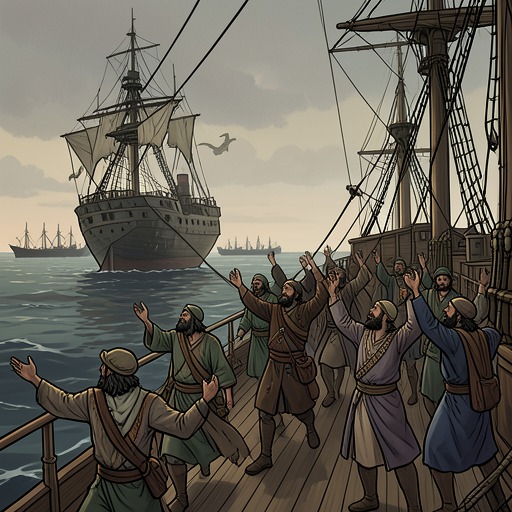
Destruction of the Invading Fleets
The Blazing WorldThe Destruction of the Invading Fleets marks the turning point at which the Empress’s return to her native country becomes a campaign of conquest. She arrives claiming to defend a threatened people, but the destruction of their enemies gives her the means to make the King of Esfi master of the seas and to impose tribute on other nations. A rescue becomes the foundation of an expanding imperial order.
Causes and Intervention
The Empress learns that most of the world has resolved to make war on her native country and weaken or destroy its naval power. She writes to its general and commanders, presenting herself as a powerful princess from another world and asking them to declare when they want her assistance. The commanders’ council cannot agree on an answer. Their delay angers her so much that she considers returning to the Blazing-World without helping; the Duchess persuades her to make allowance for a council divided among many opinions.
The Empress then addresses the countrymen who do not recognize her. She says she has crossed from another world to help them, placing their safety above her own tranquility, riches, and pleasure. She promises to make them the most powerful nation in the world and to destroy their enemies before nightfall. Her stated purpose is defense and loyalty to her birthplace; her promise of overwhelming power already points beyond the immediate rescue.
The Naval Battle
On the morning of the battle, the Empress appears above the water in imperial robes set with diamonds and carbuncles, carrying a carbuncle buckler and a diamond spear. A star of Star-stone crowns her cap, and a crescent of the same material rests on her forehead. She directs the Fish-men to approach the enemy vessels with Fire-stones concealed in diamond cases, uncover them only when close alongside, then wet them and set the ships alight. The flames reach the powder stores, and the hostile fleets are destroyed in a short time.
The spectacle transforms the countrymen’s interpretation of her arrival. After her earlier appearance had provoked conflicting judgments—some regarded her as an angel, others as a sorceress, goddess, or devil—the destruction of the fleets leads them to acclaim her as an angel sent by God. The Empress does not return to the Blazing-World after this victory: she remains until she has forced the rest of the world to submit to her native nation.
From Rescue to Tribute
The King of Esfi thanks the Empress for the naval victory but explains that hostile powers still hinder trade and commerce in his dominions. She answers that she will burn or sink ships that refuse to pay him tribute, then demands tribute from neighboring nations engaged in sea trade. They reject the demand, so she orders the Fish-men to destroy foreign ships. Facing the loss of their commerce, the nations seek negotiations, but she offers no alternative to submission and payment. They are eventually forced to comply, making the King of Esfi master of the seas and, through the importance of maritime trade, of the world.
That settlement proves unstable. Neighboring nations soon judge themselves so subordinated that they can scarcely move beyond their own dominions without paying a costly tribute, and they unite their forces against the King. The Empress again sends the Fish-men to destroy their remaining naval power, forcing them back into submission. Some nations refuse because they can live without foreign trade or conduct their commerce by land. The Empress threatens to burn their towns and cities if they do not submit; when they reject her demand, she prepares a further campaign using Bird-men and Worm-men to attack their settlements.
Significance
The episode’s political logic sharpens as it proceeds: assistance is offered in the name of safety, but the victory becomes the justification for compulsory tribute, and resistance to that arrangement brings renewed destruction. The Empress’s promise to make her homeland powerful is fulfilled by controlling the sea routes on which other nations depend. Her intervention thus does more than defeat an invading force; it converts a defensive alliance into a world-spanning hierarchy, maintained by the threat and use of military force.